
Everyone has an inner child. Some of us had a nice childhood, for some this time in life was not so splendid. But how do we know, if we have a wounded inner child?
Well, are your reactions too strong sometimes? It means that an event or another person’s claim causes you to react strongly, mostly with anger, rage, blame, etc. You are suddenly attacking someone, even you had no intention to do so?
Or maybe, your reaction is quite the contrary. Someone is rude, accusing you of something, but you freeze, you are unable to defend yourself, you become quiet – as if you would accept all the charges?
When you think back about your reactions, the funniest thing is you cannot explain why you have reacted in this way, right? There is no apparent reason, explanation. You may even be mad at yourself, blaming yourself afterward for this. Sounds familiar?
Congratulations. You have just met your wounded inner child.
In analytical psychology, the inner child refers to an individual’s childlike aspect. Your inner child is an unconscious part of who you are. You were once a child, and this part lives in you until today.
If you had an unhealthy childhood, you had to deal with your parents’ unfavorable circumstances, harmful behavior, or some trauma, you were emotionally wounded as a child. It happened to all of us, more or less.
You may have learned to internalize negativity, a particular outlook on life, a certain mindset. If you were mistreated, you may learn to think that this is what you deserve. In that way, your inner child may have become wounded, and you have not gotten over the pain of an event. You are probably still carrying this pain with you, in your subconscious part, and it is getting triggered now and then. Maybe often, actually.
If this applies to you, you may have a wounded child:
- Fear of abandonment. This may be conscious, but mostly you are not aware of it. Do you feel people are going to leave you, maybe you feel unworthy of love? Perhaps you are pushing people away because you think you are unworthy of love and better to be alone. If you fear ob abandonment, you will do anything to prevent this to happen. Even if the relationships are bad. You cannot imagine yourself doing good on your terms, you are asking yourself: “Nut, what will I do, if I stay alone?”
- You are your worst critic. Do you constantly criticize yourself, do you find something wrong with you very often? Do you feel inadequate?
- You feel responsible for others. This one may be deeply rooted in your subconscious, but in a way you feel for most other people’s trouble like it is your responsibility to do something, to help, to solve the problem. Do you feel more responsible for others, than you do for yourself? Do you even take yourself into consideration?
- You feel guilty. You carry some inappropriate guilt, guilt that does not apply to you. When adults make children responsible for things that are not in their control, this may lead to feelings of guilt. Did parents blame you or make you guilty of things? You can quickly feel guilty, and therefore, you behave defensively. You feel like you are under attack. Or the “blame game” seems to be your favorite thing? Someone has to be blamed; otherwise, the situation is not resolved.
- You have trust issues. Were you lied to, cheated, etc. You develop trust issues as a defense mechanism. You learned that people could not be trusted.
- Do you have a fear of setting boundaries? Sometimes you don’t even know what boundaries are! Boundaries are rules we made for ourselves to determine how much people will get away with or how much we allow people to get into our personal space. In other words, what we will tolerate and what not.
There are many different aspects: are you a people pleaser? ( I am certainly guilty of that!) You cannot say no to people, right?
- You get angry quickly. When you lose your temper often, this is a sign of an issue. Maybe you are holding to a time when your needs were not met. Maybe your circumstances were unfair and frustrating. Somewhere deep inside you are dealing with the feelings of a victim, maybe at that time in your life, you had no control over the circumstances you were in, you were helpless.
- You have trouble saying no. This may be connected with people-pleasing, setting boundaries, or fearing abandonment. Either way, you normally trade your time and energy for something you did not even want. You may be asking yourself: “How exactly did I get into this again?” You were on autopilot, on your inner programming, which took the charge.
- You have trouble letting things go. Do you continue to think about arguments long after they are over? Or maybe you are repeating your explanations over and over again, or you cannot stop blaming? You want to accomplish something, you do not even know what?
We tend to bury our traumas, and they come up every now and then. Normally they are triggered by something, and at that moment they just take over. They are the pilots of our behavior. When we look at our past traumas, we begin to understand our behavior. And healing your inner child really starts with expressing authentically, with expressing our feelings, with acceptance of that what we feel. Maybe we still feel shame, anger at ourselves, etc. for feeling the way we feel. But it is the first step in healing. Just be patient with yourself, you will slowly learn to be compassionate with yourself too.
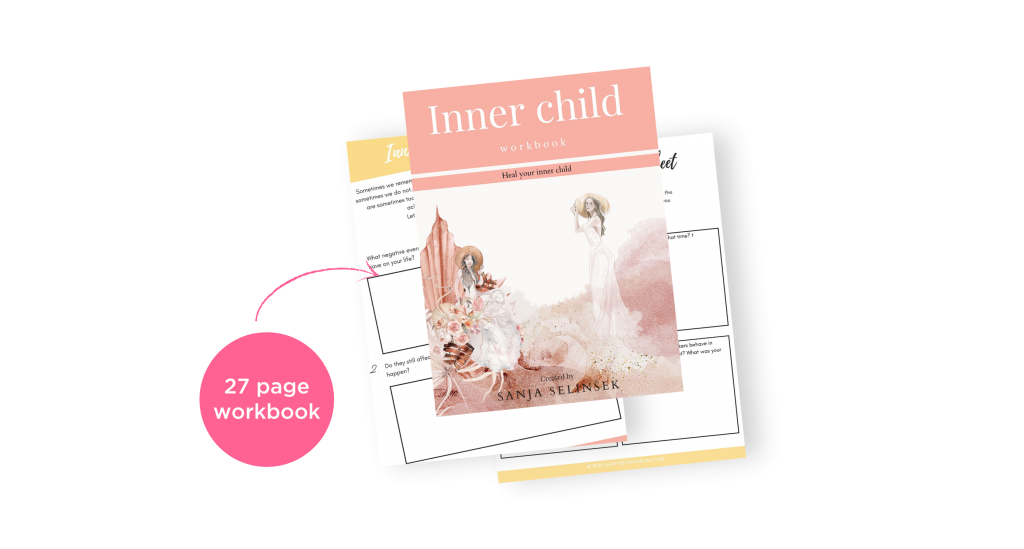
For a deeper dive into the work of inner child healing, you can grab the Inner child workbook. Read more about it here.










No Comments